




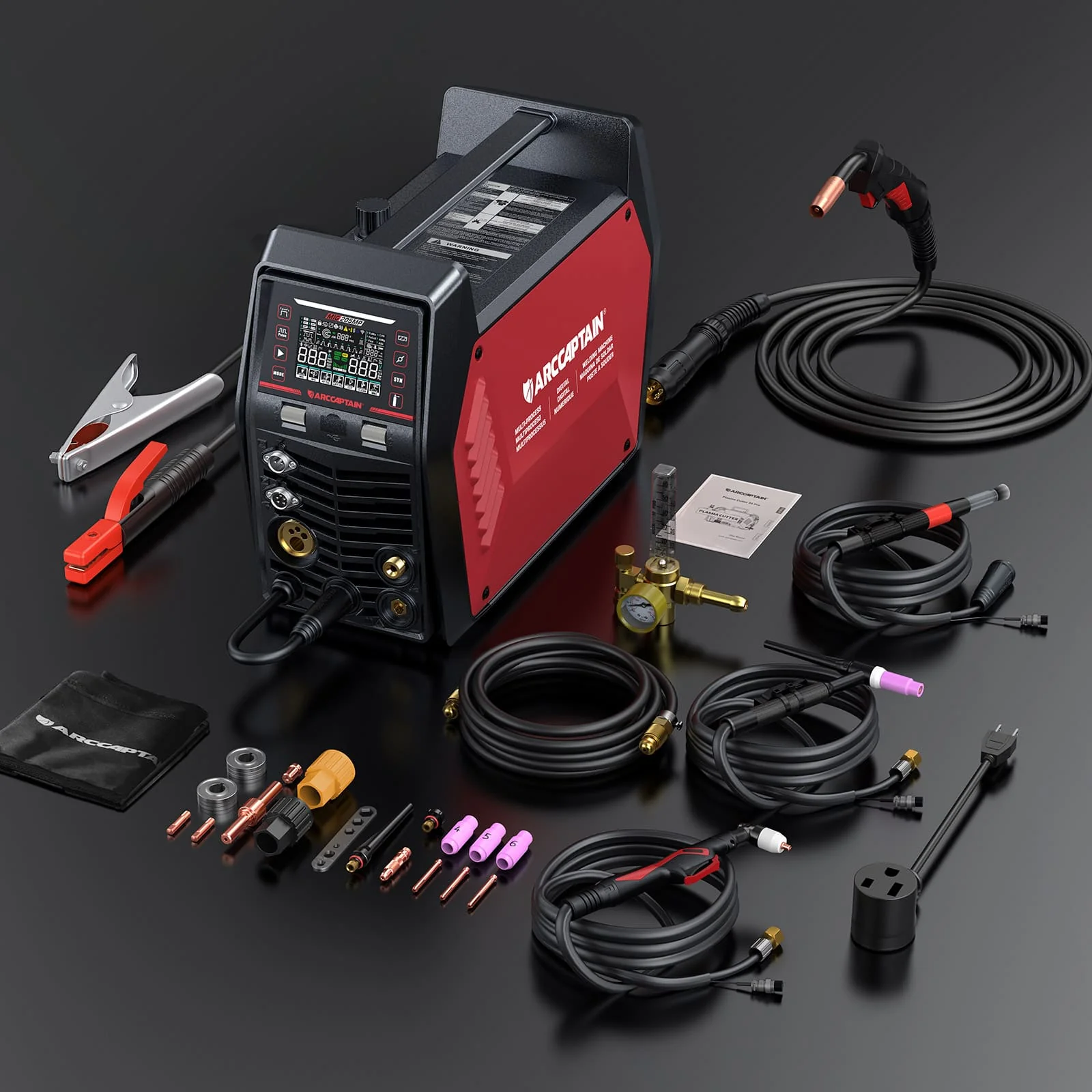
Welding machine mistakes rarely come from faulty equipment. More often they come from skipped steps, mismatched settings, or a process chosen for the wrong job. MIG, TIG, and Stick machines each demand different habits, and beginners frequently apply one process’s logic to another. Looking at where operators go wrong with Arccaptain equipment reveals patterns that show up across skill levels alike.
Synergic Mode Misuse: Why Auto-Setup Alone Won’t Guarantee Clean Welds
Synergic mode on a machine like the MIG200 lets an operator pick wire diameter and material, and the system suggests voltage and wire feed speed. That convenience leads some beginners to assume the machine will compensate for everything else. It will not adjust for a dirty joint, incorrect gas flow, or a torch angle held too far from the work surface. Treating synergic settings as a finishing touch, rather than a replacement for fundamentals, is one of the more common welding machine mistakes seen among new operators.
Confusing MIG, TIG, and Stick Welding Processes: When to Use Each Method
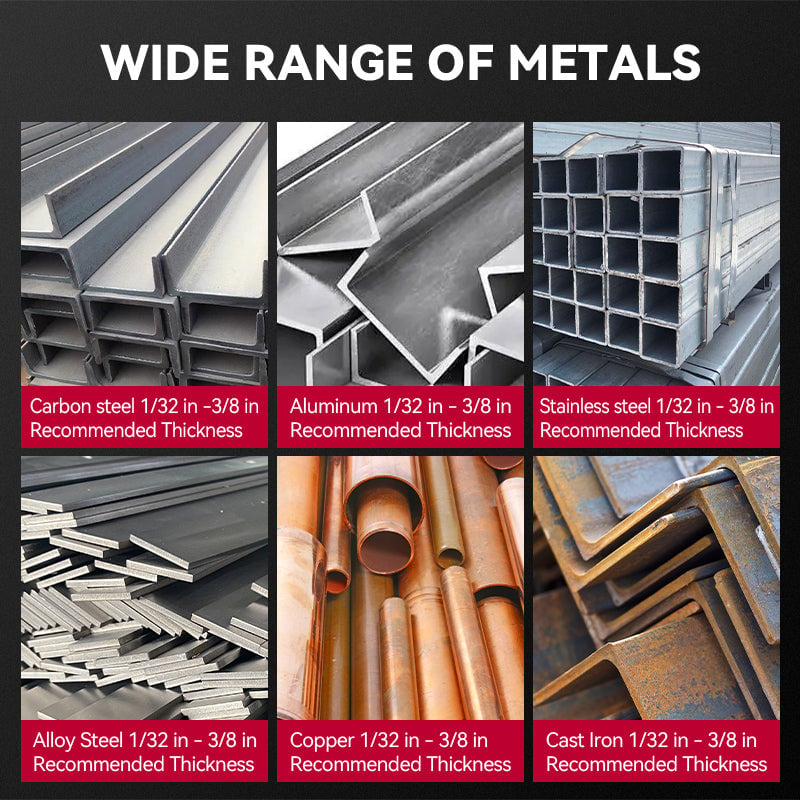
MIG welding suits faster production work and thinner sheet metal, while Stick handles rougher or outdoor conditions with less concern for wind. TIG, by contrast, rewards a steady hand and suits thin or precision joints, including aluminum and stainless steel. The Arccaptain MIG200 covers MIG, flux core, Stick, lift TIG, and spot welding in a single unit, so the choice of process has to be made deliberately rather than left to whatever mode was last used. Picking Stick for a thin aluminum panel, or MIG for a joint that demands tight heat control, produces predictable problems regardless of how capable the machine is.
The MIG200 and Aluminum Welding: Avoiding Spool Gun Setup Failures
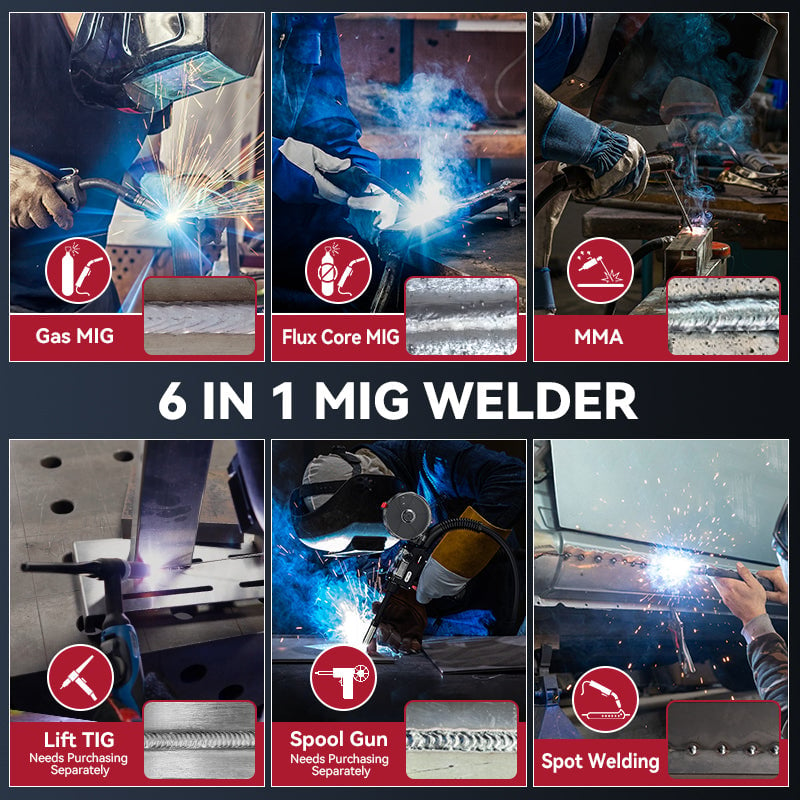
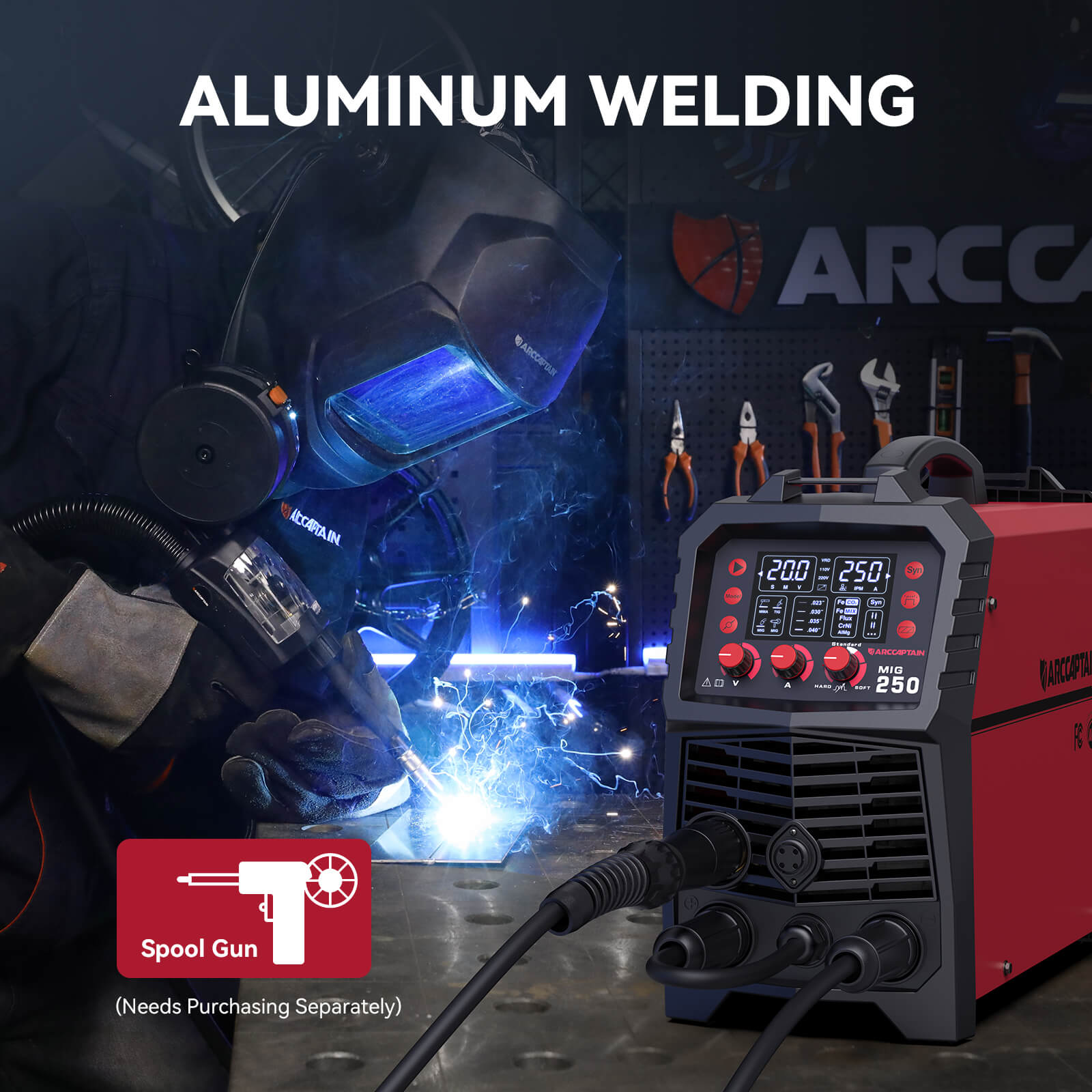
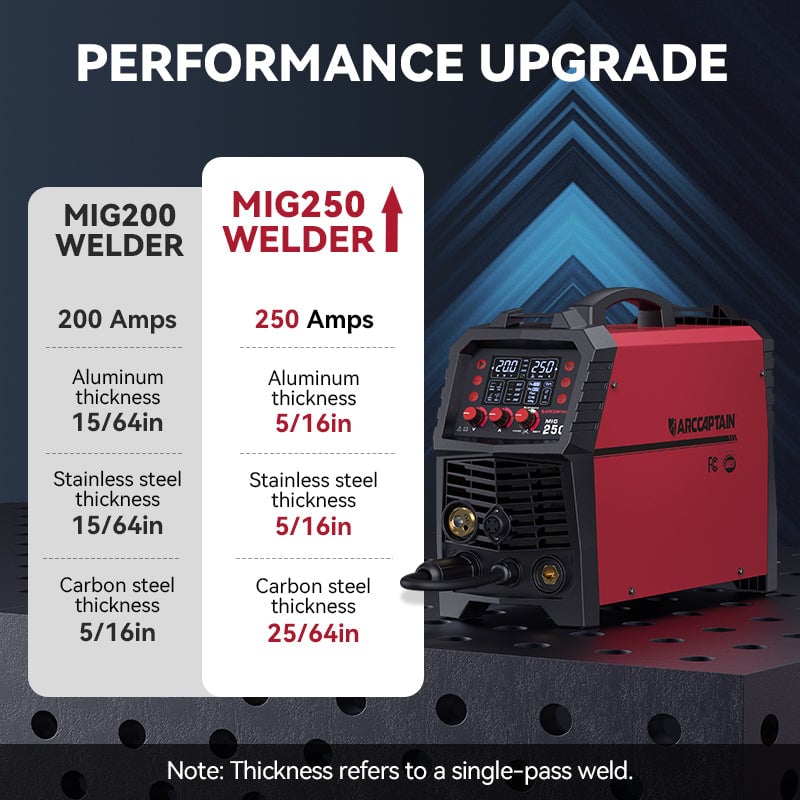
Aluminum welding on the MIG200 requires a spool gun connection, since standard MIG guns are not built to push soft aluminum wire through a long liner without birdnesting. Beginners sometimes skip adjusting feed tension or polarity settings specific to spool gun use, assuming the switch is purely mechanical. That oversight leads to inconsistent feeding and weak beads, even though the machine supports aluminum, copper, and alloy steels across its working range. A separate kit from Arccaptain pairs a welder with a spool gun from the outset, which removes some of the guesswork around compatible accessories.
AC/DC Confusion in the TIG200P: Pulse Waveforms and Distortion Control
The TIG200P supports AC TIG, DC TIG, pulse TIG, and Stick, with adjustable square, triangle, and pulse waveforms. AC current suits aluminum because it cleans the oxide layer during welding, while DC current suits steel and stainless steel. A frequent error is leaving the machine on the wrong current type for the base metal, which produces poor arc stability or a dirty-looking weld pool. Pulse settings on this TIG model are meant to reduce heat input and limit warping on thinner material, but that benefit disappears if the waveform is never adjusted away from a default setting.
Plasma Cutter Misconceptions: Pilot Arc and Material Thickness Limits
Pilot arc technology, found on the CUT55 Pro, allows non-contact cutting, which is useful on rusty, painted, or expanded metal surfaces. Some operators expect pilot arc alone to compensate for exceeding the rated capacity of the machine. The CUT55 Pro is dual voltage, rated for a clean cut around 1/4 inch at 120V and up to 1/2 inch at 240V, with a maximum severance cut listed separately from the clean-cut figure. Pushing material beyond those limits, or running on the lower voltage while expecting the higher-voltage result, is a repeated source of rough or incomplete cuts.
Overlooking Foot Pedal Control on Premium TIG Setups
The TIG200P is also offered in a kit with a foot pedal, which allows hands-free amperage adjustment during compatible TIG applications. Many beginners weld with a fixed amperage from start to finish, missing the chance to taper heat down at the end of a bead to avoid crater cracking. This is less a hardware gap than a technique gap, since the pedal is available but underused by operators unfamiliar with foot-controlled welding. Learning to modulate current mid-weld is one of the more technical skills separating consistent results from inconsistent ones, and Arccaptain includes this option on more than one TIG200P configuration.
Across MIG, TIG, and Stick processes, most welding machine mistakes trace back to process selection, setting mismatches, or skipped technique rather than the equipment itself. The list below summarizes common operator errors that undermine weld quality or leave features unused.
- Running synergic mode without cleaning the joint or checking gas flow first.
- Using Stick settings on thin sheet metal that calls for MIG or TIG instead.
- Connecting a spool gun without adjusting feed tension for aluminum wire.
- Leaving a TIG machine on DC current when welding aluminum that requires AC.
- Ignoring pulse waveform adjustments meant to reduce distortion on thin material.
- Attempting a severance cut thickness with a plasma cutter set for clean-cut use only.
- Cutting on a lower voltage setting while expecting results rated for the higher voltage.
- Welding a full bead at one fixed amperage instead of tapering current with a foot pedal.
Equipment quality sets a ceiling on what a weld can achieve, but technique decides whether that ceiling is ever reached. The Arccaptain range covers multi-process MIG welders, AC/DC pulse TIG machines, and dual-voltage plasma cutters, each with specific settings meant to match a particular material or joint. Reviewing how synergic modes, current types, and pedal controls actually function remains the more reliable path to a clean weld.
Avoiding welding machine mistakes comes down to matching process, settings, and technique to the job at hand.