




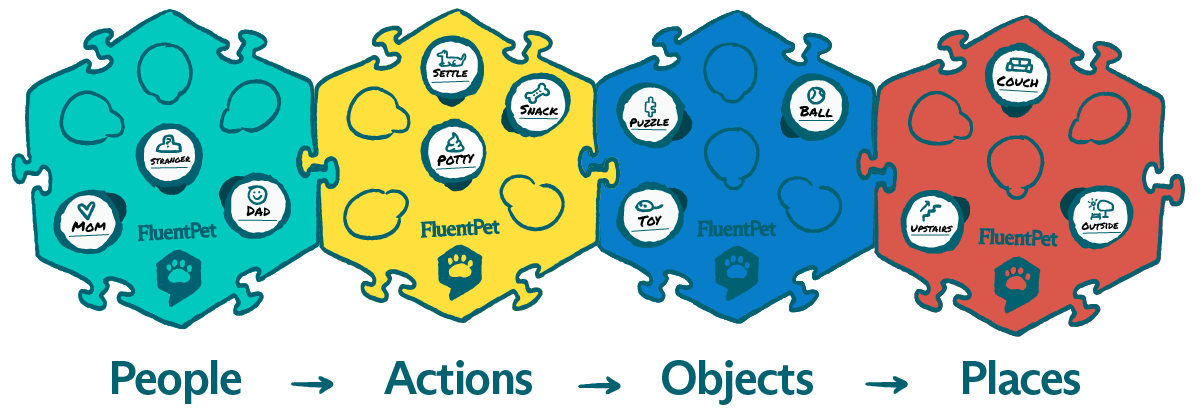
Cats and dogs cannot speak human language, but many owners now report something close to it through recordable sound buttons. Talking buttons for dogs and cats let a pet press a word instead of just whining, scratching, or staring at the door. The fluent.pet system is built around this idea, pairing individual buttons with a tile-based layout so animals can build an expanding vocabulary over time.
How Talking Buttons Enable Pet-to-Owner Communication
A single talking button holds one recorded word or phrase, triggered when a paw or nose presses it. Over repeated use, a cat or dog can learn to associate the sound with an outcome, such as going outside or getting a meal. This turns a one-way routine, where the owner guesses what the pet wants, into something closer to a two-way exchange. it states that its buttons are used by Bunny the Talking Dog and by most of the leading button teachers recognized in this space.
Because each button is independently recordable, households can phrase words in their own voice and tone. That matters for small multi-pet homes, where more than one learner may need to press buttons for different needs at different times. Talking buttons for dogs and cats are not a single gadget but a growing set of labeled words that reflect what a specific animal and household actually need to say.
Understanding the HexTiles Organization System

fluent.pet organizes its buttons using HexTiles, a hexagonal tile format designed for memorable concept grouping. The company describes this layout as inspired by the Fitzgerald Key, a reference framework for organizing communication concepts. Tiles interlock with one another, which keeps buttons from sliding apart as a vocabulary grows across a room or hallway.
The hexagonal shape allows new tiles to be added on any side, so a layout is not boxed into a fixed grid. This supports a sense of place, where directional or category-based words tend to stay in the same relative spot. According to fluent.pet, this consistency helps facilitate multi-button communication rather than scattering unrelated words at random.
The Speak Up! Kits: Modular Expansion for Growing Learners
The Speak Up! line includes kits such as the Get Started Kit and the Key Vocab Kit, aimed at different stages of building a working vocabulary. These kits are structured to be modular, meaning additional tiles and buttons can be layered onto an existing setup rather than requiring a full replacement. the brand also offers a Kit Builder option, letting a household assemble a combination suited to its own pace.
Alongside the Speak Up! kits, fluent.pet lists Connect Kits, described as a way to track progress as a learner’s vocabulary develops. This pairing of a starting kit with an expansion path reflects the brand’s broader approach of treating communication as an ongoing project rather than a single purchase. A Tester Kit is also listed among the current offerings for households that want to try the format first.
Ultra-Easy-to-Press Button Design for Cats and Small Dogs

Button design matters because not every learner has the same paw strength or body size. fluent.pet describes its buttons as ultra-easy to press, specifically built with cats and small dogs in mind. This design choice addresses a practical barrier, since a button that requires too much force may discourage repeated use by a lighter-framed animal.
The buttons sit directly on the HexTiles, which keeps them from shifting underfoot during a press. Durability also plays into day-to-day practicality, since the tiles are described as non-slip, which supports stable footing for pets stepping onto them repeatedly. This combination of accessibility and stability is central to how it frames its design philosophy.
High-Quality Sound in the FluentPet System

Sound clarity is a stated priority for fluent.pet, which describes its buttons as offering the highest quality sound so that recordings are easy to hear and understand. This applies both to the pet learning the word and to the humans listening for it from another room. A muffled or inconsistent playback could make it harder to tell similar-sounding words apart, so clear audio output supports the larger goal of reliable pet-to-owner exchanges.
Because each button can be re-recorded, sound quality also affects how consistently a word is represented over time. A clean, audible press helps keep the association between sound and meaning stable as a vocabulary grows. This is one of the core features fluent.pet highlights when explaining why its system works the way it does for both cats and dogs.
Building Multi-Button Vocabulary: From Starter to Advanced

As a learner becomes comfortable with a handful of words, households often add more HexTiles to introduce new concepts. The interlocking format means the layout can grow outward, keeping earlier words in place while new ones are added nearby. the brand frames this expandability as central to its system, noting that tiles are designed for expansion customized to a learner’s own journey.
fluent.pet also references an app-integrated option as part of its broader lineup, positioning it as part of what the company calls its most advanced system. Reviews referenced by the brand point to more than 50 million button presses recorded across its community of users. That figure suggests a wide base of households experimenting with multi-button vocabularies rather than a handful of isolated cases.
- HexTiles are built to be durable and non-slip, supporting repeated use by pets stepping on and off the layout.
- Buttons are designed to be ultra-easy to press, with cats and small dogs specifically considered in that design.
- Sound output is built for clarity, so both the learner and the household can recognize each recorded word.
- The interlocking tile format allows a vocabulary to expand gradually through additional HexTiles and kits.
- Kits such as Speak Up! and Connect Kits offer a modular starting point that can grow alongside a learner’s progress.
Taken together, these design choices describe a system built less around a single product and more around an expanding set of tools. As more households try talking buttons for dogs and cats, the appeal seems to rest on this flexibility, letting a vocabulary grow one hexagon at a time.