



Picking a new kettle usually comes down to a handful of practical questions: how fast it boils, how much water it holds, and how it is controlled. An electric kettles comparison across the Geepas range shows how wide that spread can be, from simple stainless steel jugs to voice-controlled smart kettles. This breakdown looks at what separates each type and where the differences in power, capacity, and control actually show up.
Traditional Stainless Steel Electric Kettles in the Geepas Range
The simplest entry point in the lineup is the stainless steel electric kettle built for everyday boiling without extra features. The Geepas 2200W Double-Walled Stainless Steel Electric Kettle holds 1.7L, which suits a household or a small office making several hot drinks in a row. Its double-walled construction is a structural detail rather than a smart feature, and it pairs a 2200W heating element with straightforward on-off operation. This type of kettle sits at the most manual end of any electric kettles comparison, relying on a simple switch rather than digital settings.
Double-Walled and LED Glass Kettle Options
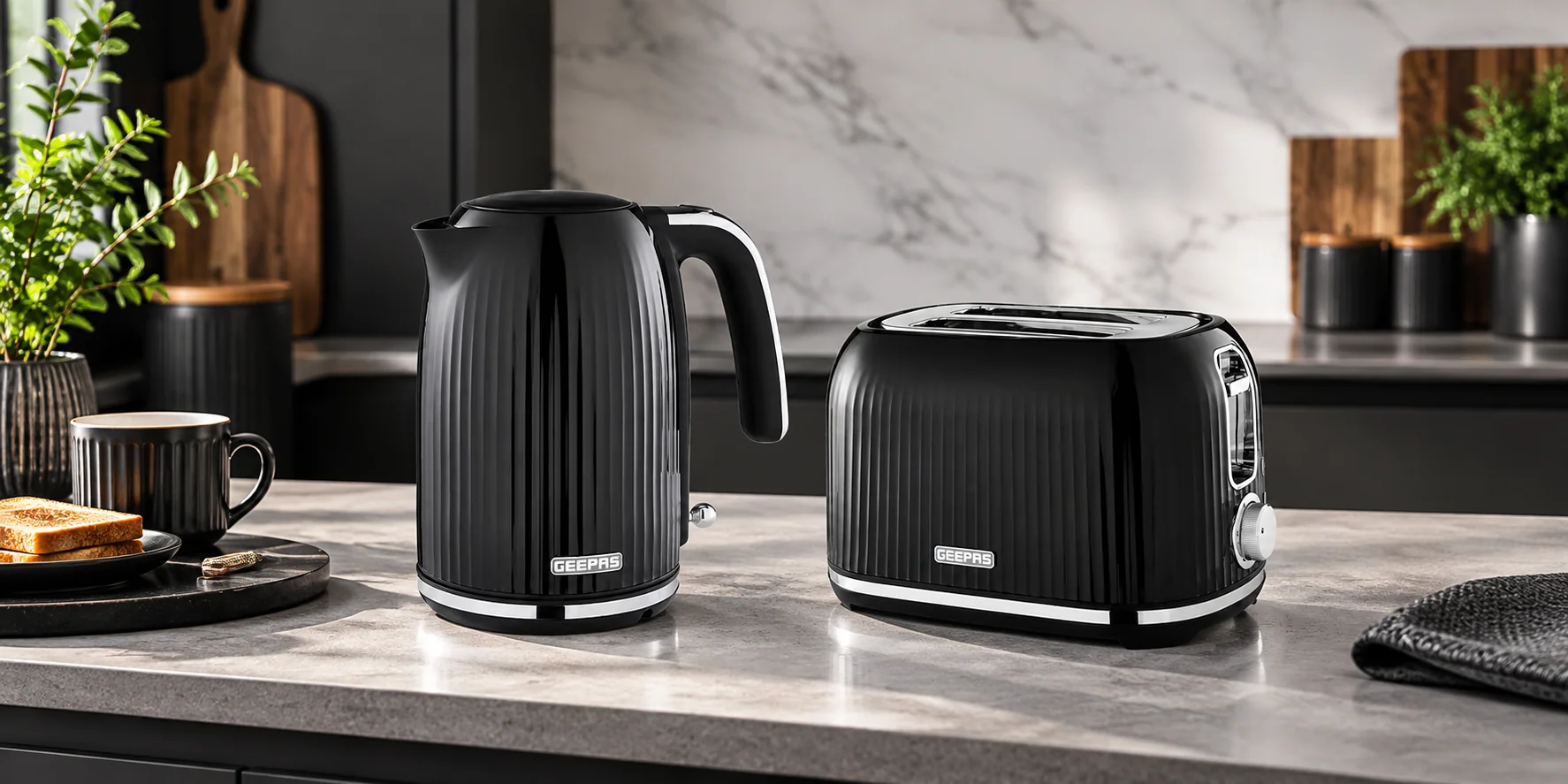
Moving away from brushed steel, the range also includes glass kettles designed around visibility and a fast boil. The 1.7L Illuminated LED Fast-Boil Clear Glass Kettle runs on 3000W, noticeably higher than the 2200W rating found on most stainless steel models, and its crystal-clear glass housing with LED illumination lets the water be watched as it heats. A related option, the 1.8L Black Electric Glass Kettle sold as part of a toaster set, adds a 360-degree swivel base and an automatic shut-off feature. Between the double-walled steel build and the illuminated glass body, these two kettle types show how material choice changes both the look and the wattage profile of a kettle within the Geepas range.
Digital Touchscreen Control and Temperature Precision
A step up in control comes with the 1.7L Digital Touchscreen Electric Kettle With Temperature Control. It keeps the same 1.7L capacity and 2200W output found elsewhere in the range, but replaces the manual switch with a digital touchscreen interface. That interface is described as giving temperature control for brewing, which matters for anyone running an electric kettles comparison that needs more than a single rolling boil setting. The brand positions this model as a cordless kettle, meaning the heating base is separate from the jug itself for easier pouring and refilling.
Smart Kettles With Voice Control Integration
At the top of the control spectrum sit the smart kettles built for voice-assisted operation. The 1.7L Stainless Steel Smart Kettle With Alexa Voice Control shares the familiar 1.7L capacity and 2200W heating power, but adds Alexa compatibility on top of the brushed stainless steel finish. A closely related variant, the 1.7L Stainless-Steel Smart Kettle, extends that voice support to Google Assistant as well, giving two major voice ecosystems a way into the kitchen. Both smart kettles keep the same core specifications as the standard stainless steel models, so the step up to smart functionality does not come with a change in capacity or wattage.
Power and Capacity Specifications Across Geepas Kettle Models
Looking across the catalogue, 1.7L is the most common capacity, appearing in the stainless steel, glass, digital, and smart kettle models alike. There is also a 12V 0.5L Portable Electric Kettle built for travel, powered through a vehicle’s cigarette lighter socket rather than a mains plug, with a food-grade stainless steel housing. For anyone running an electric kettles comparison of Geepas models, this spread of capacities and wattages gives a clear sense of what trades off against what.
- Materials across the range include brushed stainless steel, clear illuminated glass, and double-walled stainless steel construction.
- Capacity mostly centres on 1.7L, though the portable car kettle offers a smaller 0.5L option and a toaster-set glass kettle reaches 1.8L.
- Wattage ratings range from 2200W on most stainless steel and digital models up to 3000W on the LED glass kettle.
- Control methods span manual switches, a digital touchscreen with temperature control, and smart kettles with Alexa or Google voice control.
- Heating speed features are marketed as fast-boil or rapid-boil across several models, including the Grey 1.7L Rapid-Boil Kettle sold in a toaster set.
Kettle and toaster combinations also sit alongside the standalone kettles in the Geepas range. The Grey 1.7L Rapid-Boil Kettle and Four-Slice Toaster Set pairs a rapid-boil kettle with a four-slice toaster for a shared kitchen setup, while the Cordless Electric Kettle and 2-Slice Bread Toaster Combo Set uses stainless steel accents for a more compact two-slice pairing. These sets do not change the underlying kettle technology, but they do show how the range bundles electric kettle designs with other countertop appliances. For households weighing a kettle purchase alongside a toaster upgrade, these combination sets offer a packaged alternative to buying each appliance separately.
Across the full lineup, the real differences in an electric kettles comparison come down to three things: how the kettle is controlled, what it is made from, and how much wattage drives the boil. Basic stainless steel models keep things manual, glass versions bring higher wattage and visibility, digital kettles add touchscreen precision, and the smart kettles bring voice control into the mix. Capacity stays fairly consistent at 1.7L across most models, which keeps the comparison focused on control and construction rather than sheer volume.
Whichever control method or material suits a given kitchen, the spread across these kettles shows boiling water has become a surprisingly varied category.