




Choosing between off-road vs commuter electric scooters comes down to terrain, tire design, and how much power a rider actually needs on a daily route. Iscooterglobal carries both styles across its line, from lightweight folding models built for pavement to heavier, suspension-equipped machines meant for rougher ground. Understanding what separates these two categories helps experienced riders match a platform to the surfaces they actually cover.
Urban Commuters: The i8, i9, i9Max, and i10Plus Series
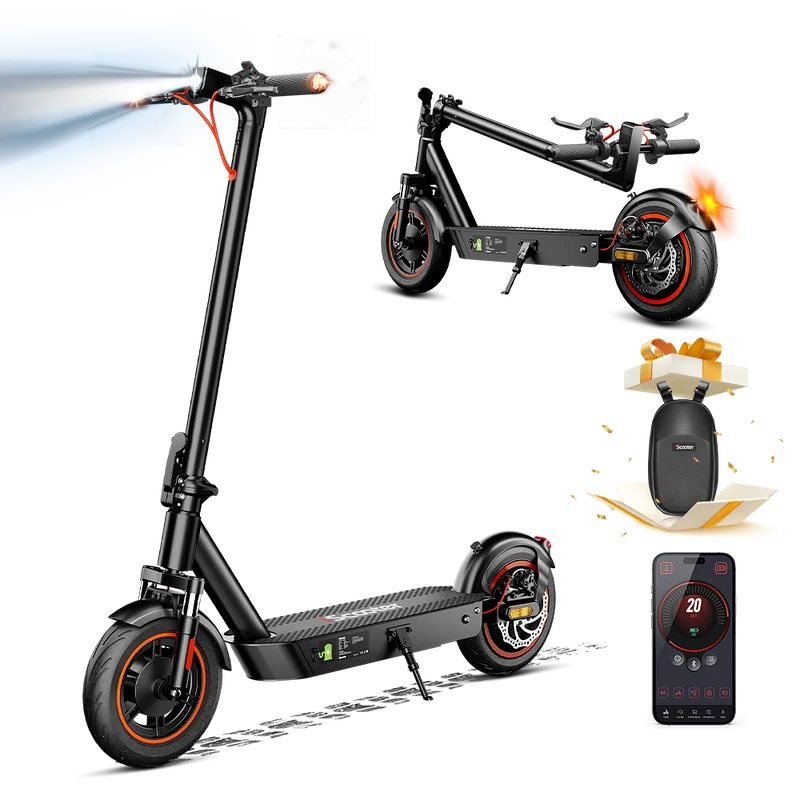
The i8, i9, i9Max, and i10Plus sit in the commuter lineup from Iscooterglobal, aimed at riders who deal with pavement, bike lanes, and short hops through traffic. The i9Max runs a 500W motor and is built around hill-climbing and responsive acceleration rather than rugged terrain work. Its battery supports a range of up to 40km on a single charge, which suits repeated daily trips without requiring a recharge mid-route. The i10Plus steps up to an 800W motor, giving it more headroom for riders who want a bit more power while still staying within a street-oriented design.
These models share a common thread of lighter frames, smaller folding mechanisms, and tires sized for smooth, paved surfaces. None of them are marketed around off-road capability, and their shock absorption is modest compared to the rugged side of the catalogue. That makes the commuter group a fairly distinct answer within the off-road vs commuter electric scooters comparison, since their entire design brief points toward city use.
Off-Road Capability: iX3, iX4, iF1, and iX5S Models
On the other side of the range sit the iX3, iX4, iF1, and iX5S, each built around stronger motors and rougher tire compounds. The iX3 carries an 800W motor and an aluminum alloy frame, and Iscooterglobal describes it as capable of handling muddy trails and rocky paths. Its battery, like the i9Max, offers up to 40km of range, though the terrain it is built for tends to demand more from a single charge than flat pavement does.
The iX4 adds auto-grade pneumatic off-road tires, widened footboards, and app control, with a full lighting system for low-visibility rides. The iF1 moves further up in motor output at 1200W, while the iX5S runs a 1000W motor alongside what the brand calls long-distance off-road terrain handling. Together, these four models represent the clearest off-road answer within the catalogue, built with frames and tires meant to absorb impact rather than simply roll smoothly.
Moped-Style Riding: The DX5 and DX5Pro with Seat Options
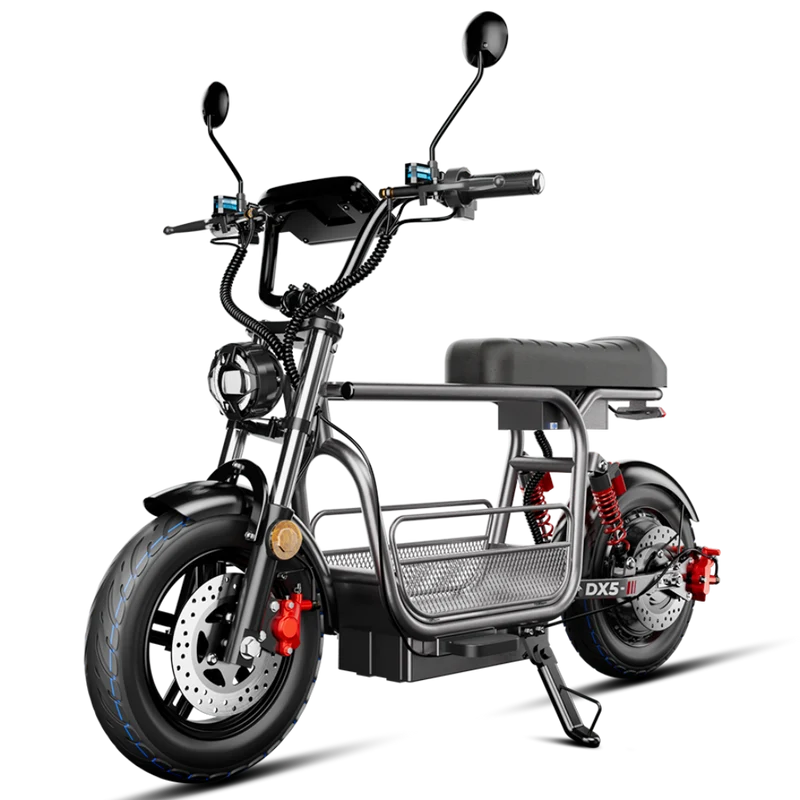
The DX5 and DX5Pro occupy a distinct spot in the Iscooterglobal lineup, styled closer to a moped than a traditional stand-up scooter. The DX5Pro is built around a 2000W motor, a built-in seat, and a large basket, with a stated range of up to 100km on a single charge. That combination of seated comfort and extended range sets it apart from both the commuter and off-road groups described above.
Both the DX5 and DX5Pro are described as suited to varied terrain, with the DX5 marketed around stability across different surfaces. The seat option changes the riding posture entirely, which matters on longer routes where standing the whole way becomes impractical. This moped-style format effectively forms a third category alongside the off-road vs commuter electric scooters split covered elsewhere in the range.
Motor Power and Acceleration Across the Range
Motor wattage climbs steadily moving from the commuter series toward the off-road and moped-style models, with the i9Max at 500W sitting well below the DX5Pro’s 2000W output at the top of the catalogue. The i10Plus matches the iX3 at 800W despite one being built for pavement and the other for rougher ground, which shows wattage alone does not fully separate the two categories. From there, the iX5S reaches 1000W and the iF1 reaches 1200W, placing both ahead of every commuter model in the lineup.
Acceleration and hill-climbing performance tend to track with that wattage, though frame weight and tire grip also shape how a motor’s output translates into actual movement. A commuter scooter rarely needs to push through loose gravel or inclines covered in debris, so a smaller motor paired with a lighter frame is sufficient. Off-road and moped-style models lean on their higher-output motors specifically because loose or uneven terrain absorbs more energy than flat pavement does.
Suspension and Terrain Handling Systems
Suspension design is one of the clearest technical dividers between the commuter and off-road lines. The iX3, for instance, includes a front and rear shock absorption system specifically built to manage the impact of uneven ground. Commuter models in the i8 through i10Plus range are not described with the same shock absorption detail, which lines up with their pavement-focused design.
Tire type reinforces this split just as much as suspension does. The iX4’s auto-grade pneumatic off-road tires are built to grip loose or broken surfaces, something a smooth commuter tire is not designed to handle. For anyone weighing off-road vs commuter electric scooters side by side, the combination of tire compound and shock absorption tends to be the most telling difference on paper.
- Commuter models like the i9Max and i10Plus favor lighter motors around 500W to 800W suited to flat, paved routes.
- Off-road models such as the iX3, iX4, iF1, and iX5S carry higher-output motors ranging from 800W to 1200W built for resistant terrain.
- Pneumatic, auto-grade off-road tires appear on models like the iX4, while commuter scooters rely on tires suited to smooth pavement.
- Front and rear shock absorption systems, as seen on the iX3, are a feature tied to the off-road side of the range rather than the commuter series.
- Stated range per charge varies by model, with the i9Max and iX3 both listed at up to 40km, while the DX5Pro extends to up to 100km.
Battery Capacity and Range by Model Type
Range figures across the Iscooterglobal catalogue depend heavily on the model and its intended use. The i9Max offers up to 40km on a charge, a figure matched by the off-road iX3 despite the rougher conditions it is meant to face. The DX5Pro, with its larger seat-equipped frame, extends well beyond both at up to 100km, reflecting its position as a longer-distance, moped-style option.
These differences show that battery capacity is not simply tied to whether a scooter is built for pavement or trails. Instead, it tracks closely with the physical size of the platform and the motor it supports. Riders comparing off-road vs commuter electric scooters for range alone may find that the moped-style DX5 series actually outpaces both other categories in stated distance per charge.